
Introduction
A single sheet of foam looks easy to cut. Stack twenty of them, add a die carrying several meters of steel rule, and the machine under the die suddenly matters. Packaging inserts, gaskets, seals, shoe soles, and acoustic parts all start as foam sheets, and most are shaped on a press. Two things affect the shop floor: the hydraulic foam cutting machine and the pneumatic press. Both push a steel rule die through the foam. They differ in force, control, speed, and upkeep, and picking the wrong one means ragged edges, slow cycles, or a machine that struggles with half your orders. Choosing between them depends on the foam, the die, and your volume. This article compares how each one works, puts them side by side, and explains which foam works best for which press. We’ll also go through the common buying mistakes and questions to ask foam cutting machine manufacturers before you commit.
How Each Machine Cuts Foam
Both machines drive a steel rule die through foam into a cutting board. What pushes the die is where they split:
1. Hydraulic Foam Cutting Machine
A pump pushes oil into a cylinder, and because oil barely compresses, pressure turns into steady, controllable force. Force equals pressure times piston area, so a 100 mm cylinder at 150 bar delivers roughly 12 tonnes. Operators can set stroke depth and stopping pressure, which protects both dies and cutting boards.
2. Pneumatic Press
Compressed air, usually 6 to 8 bar, drives the cylinder. The same 100 mm cylinder on 6 bar air produces roughly half a tonne, far less than the 12 tonnes a hydraulic foam cutting machine delivers at 150 bar. Bigger cylinders compensate, but low air pressure still caps force. Air compresses, so force at the bottom of the stroke is less exact, but the stroke is quick.
Think a packaging shop cutting tool-case inserts from 30 mm PE foam, five sheets at a time. A pneumatic press may leave the bottom sheet joined at the corners, while a hydraulic press pushes the blade through every layer.
Hydraulic vs Pneumatic: A Quick Comparison
| Factor | Hydraulic | Pneumatic |
| Cutting force | High, scales with cylinder size and oil pressure | Limited by air pressure |
| Stroke control | Adjustable depth and pressure | Quick, less exact at the bottom |
| Cycle speed | Moderate | Fast on short strokes |
| Best foam | Thick, dense, or stacked | Thin, soft, single layer |
| Purchase price | Higher | Lower |
| Upkeep | Oil, filters, seals | Air filters, seals, compressor |
| Noise | Pump hum | Air exhaust hiss |
Neither column wins outright; the foam and the die decide.
Types of Hydraulic Foam Cutting Machines
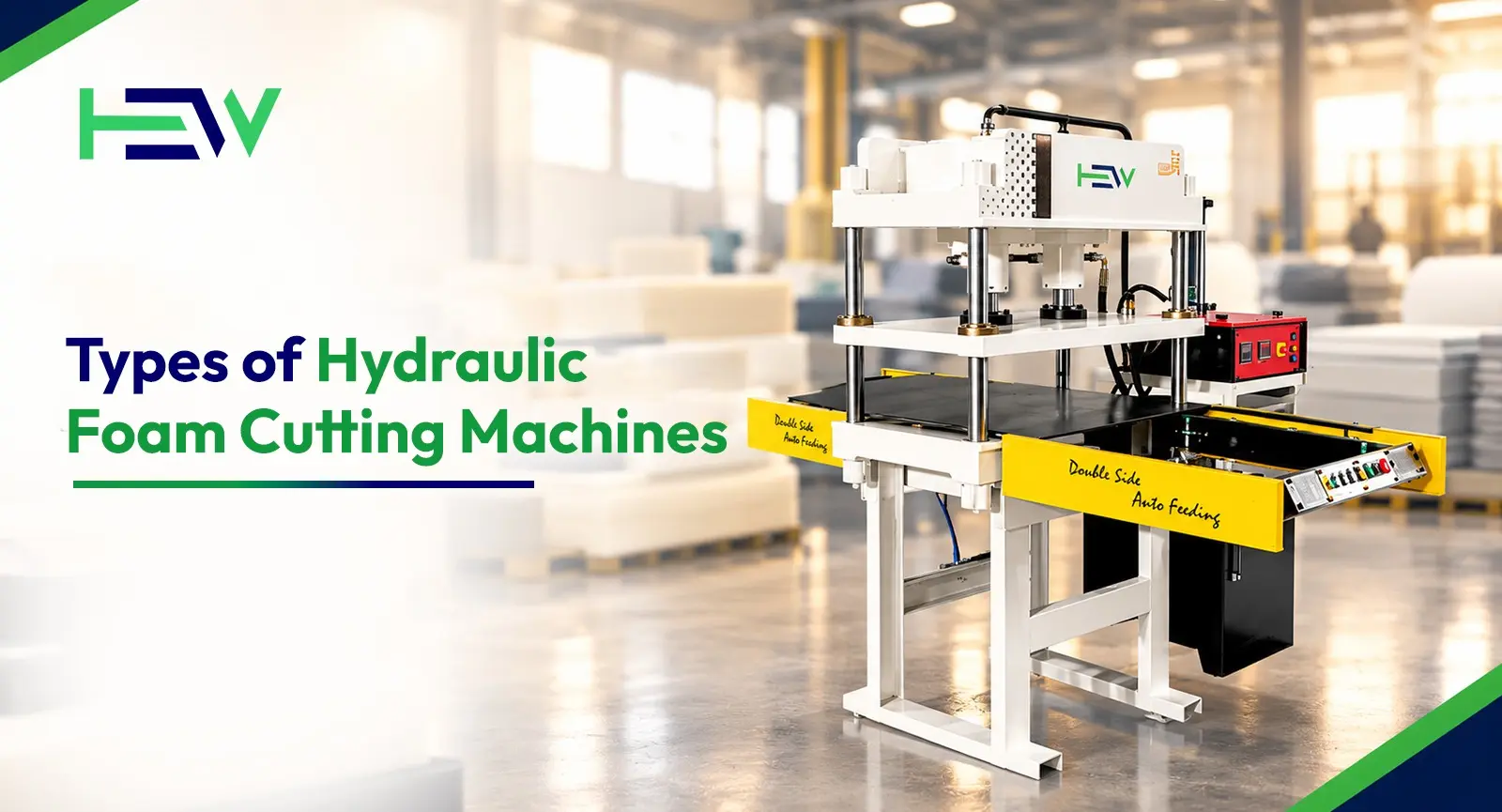
Hydraulic foam die cutting machines come in a few layouts, and the right one depends on die size and volume:
- Travelling head press: The head slides over a large cutting board, so operators place the die by hand. It suits mixed work and varied foam.
- Swing arm press: A pivoting arm brings the head over the die, a compact option for smaller shops.
- Automatic feed press: A conveyor pulls foam sheets under the head of a hydraulic foam cutting machine, which is perfect for high-volume repeat parts.
- Four-column press: Four guide columns keep the platen level, which helps with large dies and thick material.
Ask which layout matches your die sizes before comparing prices.
Which Foam Machine Suits Which Press
Match the press to the work, and start with the hardest work you run:
- Packaging inserts in PE or PU foam: Layers stack up fast, so a hydraulic press cuts several at once.
- Gaskets and seals from EVA or neoprene: Dense, closed-cell sheets resist blades, so hydraulic force keeps edges clean of the hydraulic foam cutting machine.
- Thin, soft foam in short runs: A pneumatic press cuts single layers quickly and costs less to own.
- Footwear and insole parts: Thick EVA with large dies usually calls for a hydraulic travelling head press.
For whole slabs or 3D contours, a CNC knife cutter is the better tool than any press.
Choosing the Right Hydraulic Foam Cutting Machine
Make sure you consider the five checks mentioned below before talking to foam cutting machine manufacturers:
- Measure the die: Add up every blade length on your largest die, because required force grows with it.
- Note the foam: Record the type, density, and how many layers you stack.
- Check the platen: Make sure it fits your biggest die with space to spare.
- Plan the volume: Daily parts and repeat orders decide whether automatic feed was useful or not.
- Confirm safety: Look for two-hand controls and light curtains.
Give manufacturers these numbers, and they can size the machine precisely.
Conclusion
Picking between a hydraulic and a pneumatic press is easier when you start with your foam, not the machine. Thick, dense, or stacked sheets need the steady power of a hydraulic foam cutting machine. Thin, soft sheets in small batches can run happily on a pneumatic press. If you are unsure, test your own foam and your biggest die before you buy. HEW Foam Cut Machine can help guide you toward the press that fits your work and your budget.