
Introduction
A mattress manufacturer and a car seat supplier can both need a PU foam cutting machine, and still need two completely different machines. That’s the part most buying guides skip past. Polyurethane foam works differently depending on its density; the cut you need might be a straight vertical slice or a curved profile, and your daily output could range from a few dozen pieces to several tons. Picking a machine before understanding these variables is how businesses end up with equipment that technically works but never fits the work. This article is all about what separates one PU foam cutting machine from another, so you’re choosing based on your production reality rather than a spec sheet that looks impressive on paper.
What a PU Foam Cutting Machine Needs to Do
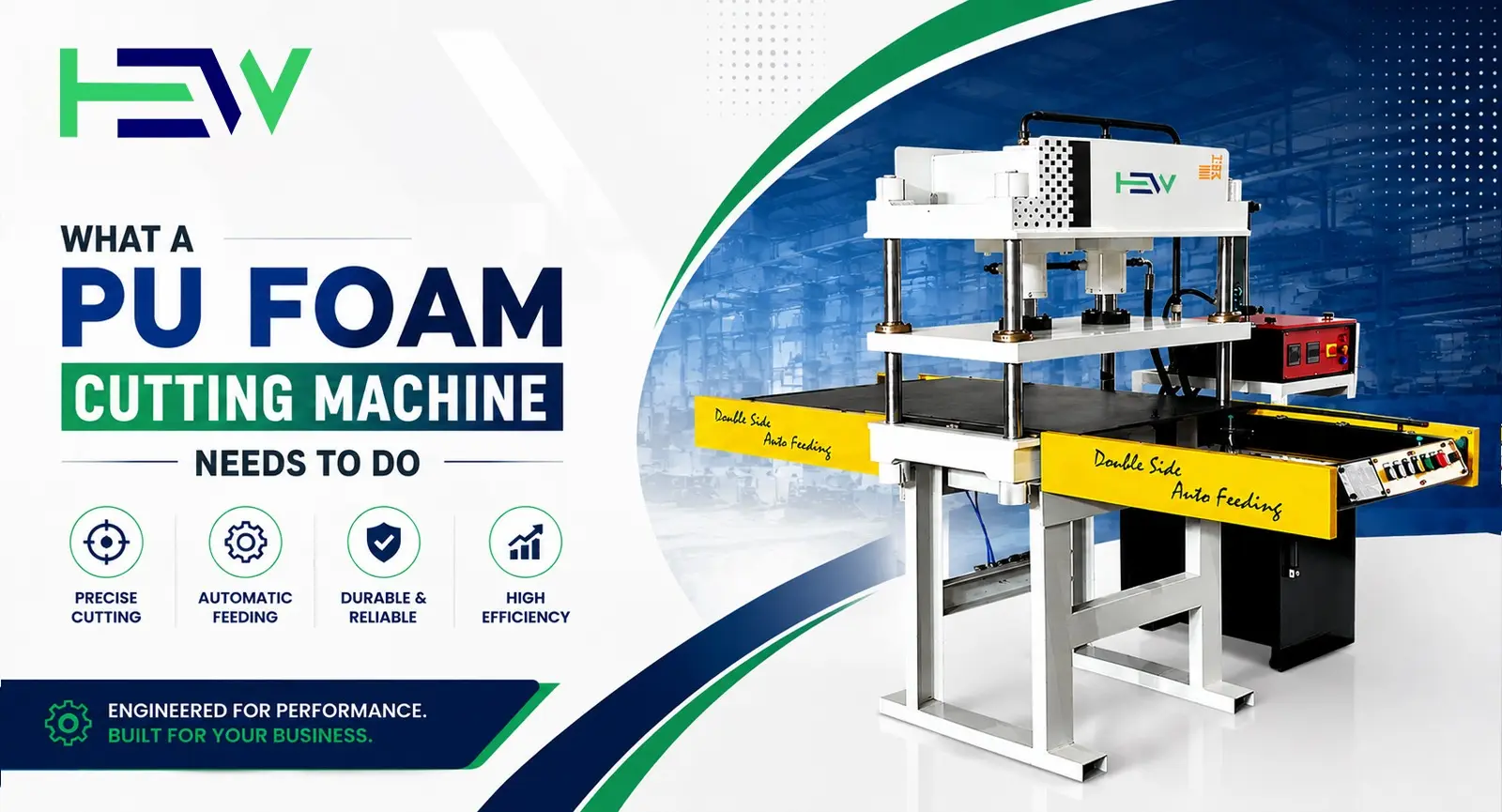
A PU foam cutting machine has one work: slice through polyurethane foam cleanly, consistently, and without tearing or crumbling the material. That sounds simple until you factor in that foam isn’t uniform. Soft, low-density foam used in cushioning works very differently under a blade than the denser foam used in insulation or automotive padding.
Most machines rely on one of two cutting mechanisms: a heated wire that melts through the foam as it moves, or a mechanical blade that slices through it. Heated wire tends to leave smoother, more precise edges on softer foam, while blade-based systems generally handle denser or thicker material with less resistance. Neither is universally better; the right choice depends on what you’re cutting and how the finished edge needs to look.
Types of PU Foam Cutting Machines
Walking into this market for the first time, the range of machine types can feel overwhelming. Breaking them down by what they’re built for makes the decision considerably easier.
Vertical Foam Cutting Machines
These cut foam blocks from top to bottom, usually producing flat slabs or sheets at a set thickness. They’re common in mattress and cushion manufacturing, where consistent slab thickness matters more than intricate shaping.
- Manual vertical machines suit lower-volume operations
- Automatic versions handle repeated cuts at a faster, steadier pace
- No operator resetting required between passes on automatic models
Horizontal Foam Cutting Machines
These machines cut foam blocks lengthwise, so you end up with long sheets or boards instead of stacked slabs. It’s the setup that is useful if you’re making things like foam panels, insulation boards, or packaging inserts that need to come out as long strips. If that’s your product, a horizontal PU foam cutter is going to suit your line better than a vertical one.
CNC Contour and Profile Cutters
When a project calls for curves, angles, or custom shapes rather than straight cuts, CNC-guided machines take over. These use programmed paths to guide the cutting wire or blade through complex profiles automatically, which matters for:
- Automotive seating requiring precise contours
- Sculpted packaging inserts
- Shoe insoles where every piece needs to match a set pattern
The tradeoff is cost and a steeper learning curve on the control software, so this option makes the most sense when your production genuinely requires shape variation rather than repeat straight cuts.
Block Cut-Off and Peeling Machines
Before a foam block even gets to the shaping machine, it usually needs to be cut down to size or peeled into thinner layers first. Cut-off machines handle the trimming, cutting big blocks into sections you can work with. Peeling machines do something different: they spin the block and shave off one continuous thin sheet at a time, a bit like peeling veneer off a log. These come earlier in the line, but don’t overlook them. How well they do their work has an effect on how smoothly your PU Foam Cutting Machine and every stage after it will run.
Manual vs Automatic: Matching the Machine to Your Output
This is where a lot of buyers overspend or underspend. A manual machine, run by an operator feeding and guiding the foam through each cut, works fine for smaller operations producing modest quantities. It costs less upfront and needs less technical maintenance.
With more production volume, the systems automatically change the calculation. A well-set-up automatic PU Foam Cutting Machine can produce 3-4 tonnes of foam blocks per day, which a manual line cannot match without adding additional shifts and labour. But the initial cost of automatic machines is higher. They generally need a controlled production environment to give a consistent output. If your production is less than this level, the machine could sit idle for years before it has the chance to recover its higher price.
What to Check Before You Choose the Machine
Beyond the machine type itself, a few practical details matter more than people give them credit for:
- Noise and vibration: You’re going to be standing near this thing for full shifts, day after day, so how loud and how shaky it runs actually matters to your team.
- Build and footprint: If your floor space is tight, a sturdy, compact machine isn’t a nice-to-have; it’s the difference between fitting your line in or not.
- How easy the control panel is to use: New staff pick it up faster, and on a production floor where people come and go, that saves your training time.
- Whether it can be customized: Some suppliers will adjust the machine around your material thickness or size. Others just hand you a fixed setup, and that’s that.
Your production needs won’t stay the same forever. A machine you can adjust or reconfigure down the line is going to serve you a lot longer than one built for just one spec, forever.
Conclusion
Choosing a PU foam cutting machine really comes down to matching the equipment to your actual foam density, cutting complexity, and daily output, not picking whatever machine looks most advanced. Getting that match right the first time saves both money and downtime later. Foam Cut Machine works with businesses to figure out that fit before recommending a specific setup, rather than pushing one configuration for every buyer.